
// the game engine
There is nothing
extra to install.
The engine is not a separate product layered on top of Zanna — it is the runtime every Zanna program already links against. Rendering, physics, audio, input, navigation, asset decoding and networking are all part of the standard library, and all of it was written for this project. No SDL, no PhysX, no FMOD, no stb.
// 3d rendering
Four backends, one API
Zanna.Graphics3D picks a GPU backend automatically and falls
back to software. The choice is invisible to game code: the same calls
produce a frame on all four.
| Platform | Primary | Fallback | Parity |
|---|---|---|---|
| macOS | Metal | Software | Near-full feature parity (94%) |
| Windows | Direct3D 11 | Software | Full feature parity |
| Linux | OpenGL 3.3 | Software | Full feature parity, including SSAO, depth of field and motion blur |
| Anywhere | Software rasterizer | — | Always available; shadow maps, CSM with 3×3 PCF, normal and specular maps, per-pixel terrain splatting |
What the renderer does
- Physically based materials: metallic/roughness, ambient occlusion, emissive, normal scale, alpha modes
- Image-based lighting, clustered forward+, screen-space reflections
- Cascaded shadow maps with PCF filtering, up to four directional slots
- Soft particles, temporal anti-aliasing, reversed-Z depth, ACES tonemapping
- SSAO, depth of field, motion blur, bloom, FXAA, vignette, colour grading
- GPU skinning, morph targets, instancing, render-to-texture, cubemap skyboxes
The software path matters
The software rasterizer is not a stub. It is always available and produces the same image, which means 3D code runs everywhere — including headless machines and CI, where there is no GPU to fall back on.
It is also how the screenshots on this site could be produced
deterministically: a scene is loaded, frames are rendered, and
ScreenshotFinal() hands back pixels.
Triangle budget: the software renderer handles roughly 50K triangles at 30fps at 640×480. GPU backends handle 1M+ at 60fps.
// 2d
2D is software, deliberately
ZannaGFX rasterises 2D on the CPU and talks to the platform’s native windowing directly — Cocoa on macOS, native Wayland with an X11 fallback on Linux, Win32 GDI on Windows. There is no GPU dependency in the 2D path at all, which is what makes it identical everywhere.
Surfaces and drawing
- Canvas and pixel buffers, blitting, alpha compositing, clipping
- Vector paths, transforms and gradients
- Bitmap and vector text from BDF and PSF font parsers
- Sprites, atlases, tilemaps, particles, nine-slice panels
- A deterministic mock backend so 2D rendering can be unit-tested
Formats, decoded from scratch
- Images: BMP, PNG, JPEG and GIF decoders; BMP and PNG encoders
- Audio: WAV, MP3 and OGG Vorbis
- Models: OBJ, STL, FBX and glTF 2.0 / GLB
- Compression: gzip, zstd, lz4
- Every one of these is in-tree. That is what “zero dependencies” means in practice — the engine compiles on a clean machine with only a C compiler.
// simulation
Physics, navigation and animation
3D
- Rigid bodies and colliders with a narrowphase, contact and solver split
- Character controller with fixed-step movement
- Distance, spring, hinge, rope and six-DOF joints
- Raycast vehicle with suspension, drive and steering
- Ragdolls and cloth
- Convex hull generation via quickhull
- Navmesh, nav agents and path queries
2D and animation
- AABB and circle bodies, joints, collision layers, spatial queries
- Quadtree broadphase, 2D raycasts, A* pathfinding
- Skeletal animation with blend trees and animation controllers
- IK solvers and morph targets
- Node animation and animation players for scene graphs
// audio & input
Sound and controls
Audio
- A 32-voice mixer with LRU voice eviction
- Sounds, music, playlists and sound banks
- Procedural synthesis and generated music
- 3D spatial audio with listeners and positional sources
- WAV, MP3 and OGG Vorbis decoded in-tree
Input
- Keyboard, mouse, and up to four gamepads with rumble
- Rebindable action maps rather than raw key checks
- Key chords
- Mouse capture and first-person camera handling
// scene pipeline
From an authored file to a running level
Scenes are data files, authored in Zanna Studio and loaded by the runtime. A scene never instantiates game classes by name — game code reads the document and maps typed metadata onto its own entities, so the format does not dictate how a game is structured.
| Format | Extension | Contents |
|---|---|---|
| 2D scene document | .scene2d |
Canonical JSON, schema v1: tile layers, placed-object hierarchy and draw order, typed scalar properties, asset references, diagnostics |
| 3D scene | .scene3d |
VSCN v1–v7: scene graph, materials with embedded texture maps, lights, cameras, typed node metadata (v6), prefab reference nodes (v7) |
Getting content in
- Tiled maps in JSON and TMX form for 2D
- OBJ, STL, FBX and glTF/GLB for 3D, including cameras, lights and animation
- An offline asset pipeline via
zanna asset bake - ZPAK archives, either baked into the executable’s read-only data or shipped as a sidecar
Iterating
- Run Scene launches the owning project with
--scene <path> - Optional scene watching is a documented contract rather than an engine feature: a game that opts in re-runs its own scene-load path when the file changes, with no state migration
.scene,.leveland.vscnremain accepted legacy extensions indefinitely
// what’s built with it
Games, not benchmarks
The engine is exercised by complete games in the repository rather than by isolated demos. They are how regressions get caught.
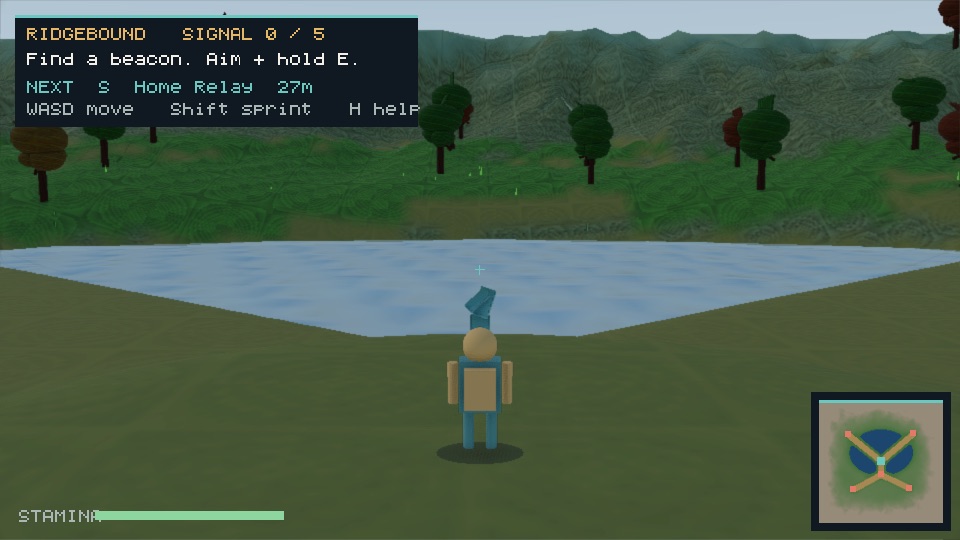
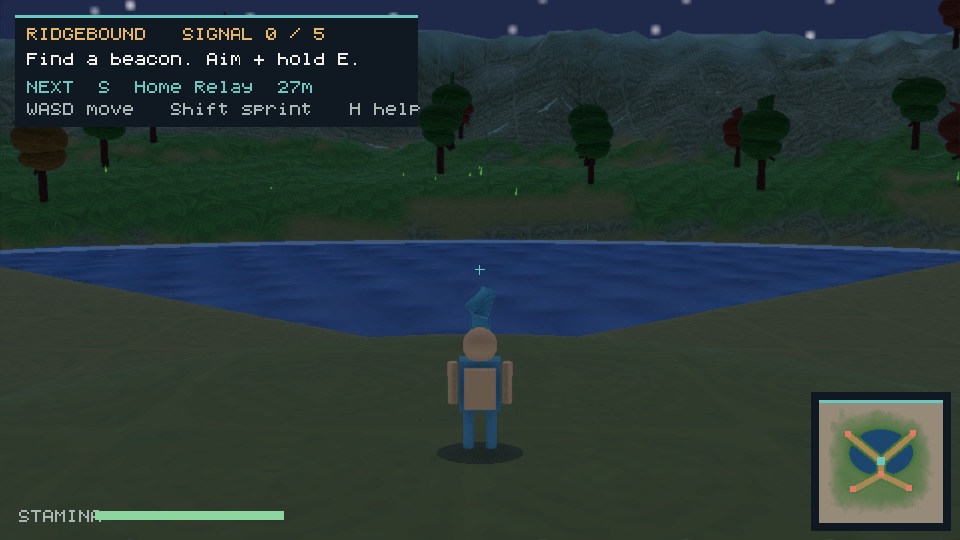
One open-world scene at two world times, captured by the game’s own smoke probe. Nothing was moved between the two frames except the clock.
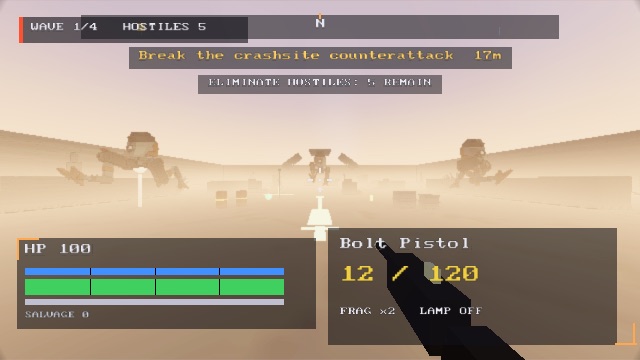
Scene-driven
- Ashfall — a nine-mission 3D FPS campaign plus a hub, with every mission loaded from an authored
.scene3d: ten weapons, eleven enemy archetypes and three bosses, navmesh routing, per-level skies and lighting - XENOSCAPE — a ten-region 2D Metroidvania whose regions load from
.scene2dfiles - Both ship probes proving the authored scenes reproduce the old code-built levels byte for byte
Also in the tree
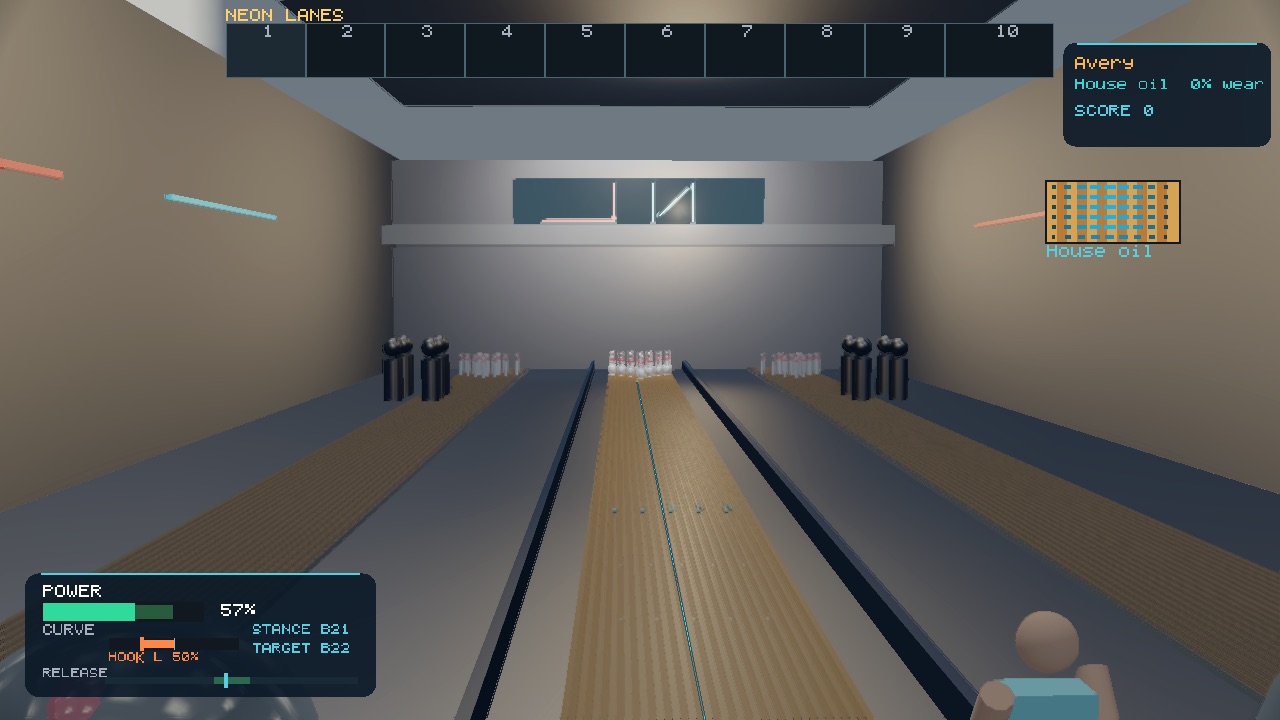
- 3D: Ridgebound (open world), 3D Bowling, 3D Baseball
- 2D: Chess with alpha-beta AI, Crackman, Centipede, Frogger, and a graphics showcase
- BASIC: Tetris, Frogger, Pac-Man and Centipede, sharing the same runtime
- Not games: ZannaSQL, a PostgreSQL-compatible database server and client; a paint app with layers and undo; a multi-threaded HTTP server
Worth knowing
- Ship games as native builds. The bytecode VM is useful for bounded probes and tests, but it is not a real-time game execution target; interactive VM launches exit with the native build command rather than opening an unplayably slow window.
- Backend parity is measured, not assumed. Metal sits at 94% of the feature set; Direct3D 11 validation depends on the Windows CI lane.
- This is pre-alpha. Runtime APIs still change between versions, and there is no compatibility promise.